
Applications Don't Get Jobs. Conversations Do. - Job search strategy

One thing stood out this week: the candidates making the biggest progress weren’t necessarily applying for more jobs; they were refusing to assume that silence meant “no”.
That is a much bigger difference than it sounds.
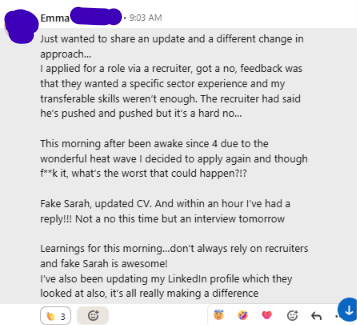
One candidate received a rejection because of sector experience- Instead of accepting it as the final answer, they contacted the hiring manager directly and opened up a conversation. They are now interviewing.
Another candidate reached a final interview but wasn’t successful. Disappointing, absolutely, but not necessarily finished. Rather than disappearing into the pile of unsuccessful candidates, they followed up afterwards with additional strategic thinking about the business and the role, giving the employer another reason to remember them.
Elsewhere, candidates secured first-round interviews from recent applications, arranged screening calls for next week, expanded their senior network through conversations, and continued building relationships with recruiters rather than sitting back and waiting for recruiters to come back to them.
None of this happened because the application process suddenly became fairer. It happened because they understood something many job seekers miss: recruitment is not a straight line.
Behind almost every vacancy are hidden variables that applicants never see. An internal candidate may suddenly become available. The hiring manager may change direction. A recruiter may filter on salary before fully understanding the person behind the application. Someone might look at a LinkedIn profile before opening the CV. A concern about sector experience might quietly remove someone from the shortlist before it is ever discussed properly. Timing changes, budgets change, and people change their minds.
From the outside, all you see is an email saying, “Unfortunately…”
It is very easy to believe that means someone carefully assessed your experience and decided you were not good enough. Often, that is simply not true.
This week, we spent time preparing one client for interview by tackling the employer’s likely concern about sector experience before it was ever raised. Instead of hoping it would not come up, we addressed it head on and built the answer properly with a job search strategy
Another member of the Sprint was encouraged by Sprint IQ to stop underselling themselves and begin targeting Head of level positions instead of continuing to aim too low.
Sometimes the biggest obstacle is not the employer. It is the story you have quietly started believing about yourself.
The people making consistent progress all seem to have one thing in common: when something does not work, they do not stop. They ask better questions.
Should I follow up? Can I contact the hiring manager? Is there another route into this organisation? Have I assumed this role is out of reach? Could I position myself differently?
Those questions create opportunities. The application itself rarely does.
Job searching is much closer to marketing than most people realise. Submitting an application is like putting an advert in front of someone, but the conversation afterwards is where trust is built, objections are answered and buying decisions are made.
The same applies to hiring.
So, if you have had a rejection this week, or you have heard nothing at all, do not automatically treat that as the end of the story. You might simply be looking at one small part of a much bigger recruitment process.
Keep creating conversations. They are still the fastest route to opportunities you cannot see yet.
If you want to see some of this advice live, come to the Job Search Reset Workshop. You can find your next date available here.


Comments